First cold snap of the year, and there it is. The tire pressure light.
Your car was fine yesterday. Now it's 30 degrees colder, and your dashboard has something to say about it.
If you've experienced this on a chilly morning in Ellisville, Ballwin, or anywhere across West County, you're in good company. Missouri temperatures can change quickly, and your tire pressure changes right along with them.
The good news? A tire pressure warning doesn't automatically mean you have a flat tire.
Sometimes, your tires just need a little air.
But before you dismiss the warning as another cold-weather inconvenience, it's worth understanding what that light means and when it could signal a bigger problem.
Why Does Tire Pressure Drop When It's Cold?
Your tires don't have to be leaking to lose pressure during a Missouri cold snap.
As the temperature of the air inside your tires decreases, its pressure drops.
That means tires properly inflated on a warm October afternoon may be underinflated after a freezing November night.
Here's the rule worth remembering:
For every 10°F drop in temperature, tire pressure typically falls by about 1 PSI.
PSI stands for pounds per square inch, the unit used to measure tire pressure.
So if the temperature drops 30 degrees overnight, your tires could lose approximately 3 PSI without having a leak.
That's enough to trigger a warning in some vehicles.
If you're wondering why your tire pressure light comes on when it's cold, the temperature change is often the first thing to consider.
Why the First Missouri Cold Snap Triggers Your TPMS Light
Your Tire Pressure Monitoring System, or TPMS, monitors tire pressure and warns you when it drops below a set threshold.
During mild weather, your tires may have enough pressure to stay above that threshold.
Then a cold front moves through West County.
The air inside your tires cools, pressure falls, and suddenly the warning light appears.
That's why so many drivers see their TPMS light for the first time when Missouri temperatures take a sharp turn.
Every first cold snap, our lot fills with pressure lights. Many are caused by the temperature change, and we can correct the pressure for free in just a few minutes.
If you're seeing a TPMS light in St. Louis, don't assume you need new tires.
But don't ignore the warning, either.
What Is Your TPMS Light Actually Telling You?
Your tire pressure light tells you that your tires need attention.
It doesn't necessarily tell you why the pressure is low.
The cause could be cold weather, a slow leak, or another tire issue.
And here's something many drivers don't realize: TPMS is a lagging indicator.
In many vehicles, the warning activates when one or more tires have fallen significantly below the recommended pressure.
That means the light isn't warning you that pressure might become low soon.
It's telling you that it's already low enough to trigger the system.
Some vehicles display individual tire pressures, while others only show a warning symbol.
Either way, the next step is to check the actual pressure.
Why Low Tire Pressure Matters on Wet or Icy Missouri Roads
A few PSI might not seem like a big deal.
But underinflated tires can affect how your vehicle handles, stops, and wears through its tread.
And those changes matter when you're driving through rain, slush, or icy patches around West County.
Low tire pressure can contribute to:
- Reduced handling performance: Underinflated tires may respond less predictably when steering or cornering.
- Longer stopping distances: Improper inflation can affect braking performance, especially when traction is already limited.
- Uneven tire wear: Low pressure can cause the outer shoulders of your tread to wear faster.
- Lower fuel economy: Underinflated tires increase rolling resistance, making your vehicle use more fuel.
- Excess heat buildup: Driving on significantly underinflated tires can generate heat and increase the risk of tire damage.
Whether you're commuting along Highway 40/I-64 or running errands around Manchester, proper inflation helps your tires perform as intended.
It won't eliminate the challenges of icy roads, but it helps you avoid adding preventable tire problems to an already difficult drive.
Don't Inflate Your Tires to the Number on the Sidewall
Here's a common mistake.
You see a PSI number molded into the side of your tire and assume that's how much air it needs.
But that number is generally the tire's maximum inflation pressure, not the recommended pressure for your vehicle.
Those are two different things.
Your vehicle manufacturer determines the appropriate tire pressure based on the vehicle's weight, handling characteristics, and other factors.
You'll usually find the recommended pressure on a sticker inside the driver's door jamb.
You can also check your owner's manual.
Always use your vehicle manufacturer's recommended cold tire pressure, not the maximum PSI printed on the tire.
Overinflating your tires can create its own problems, including uneven wear and changes in handling.
If you're unsure what pressure your tires need, stop by Ellisville Tire & Service. We'll check it for you.
Why You Should Check Tire Pressure When Tires Are Cold
For the most accurate reading, check tire pressure when your tires are cold.
That generally means before driving or after your vehicle has been parked for at least three hours.
As you drive, your tires warm up, and the pressure inside them increases.
If you check immediately after a longer drive, the reading may be higher than it would be when the tires are cold.
That's why the pressure listed on your door-jamb sticker is a cold tire pressure recommendation.
In West County, checking before your morning commute can be a convenient way to get an accurate reading.
And if you've already been driving, don't release air just because the warm tire reading is higher than the cold specification.
Let the tires cool before making that adjustment.
Cold Weather or a Slow Leak? Here's How to Tell
Sometimes, a tire pressure warning really is just a result of the temperature dropping.
Other times, the cold snap happens to reveal a leak that's been developing.
Knowing what to look for can help you decide whether you need a quick top-off or a closer inspection.
Signs It May Be a Normal Cold-Weather Drop
- The warning appears after a noticeable temperature decrease.
- Several tires show similarly lower pressure.
- None of the tires look visibly damaged or unusually low.
- Pressure remains stable after being adjusted to the correct level.
Signs It May Be a Slow Leak
- One tire is noticeably lower than the others.
- The warning returns shortly after adding air.
- You repeatedly need to refill the same tire.
- You notice a nail, puncture, or other visible damage.
- Pressure continues falling even when temperatures remain steady.
If one tire keeps losing pressure, don't keep topping it off without finding out why.
A tire inspection can help identify a puncture, valve problem, or another issue that needs attention.
What Should You Do When the TPMS Light Comes On?
A tire pressure warning deserves attention, but it doesn't always require a complicated fix.
Here's what to do.
1. Find a safe place to stop.
If the vehicle feels unstable or a tire looks severely underinflated, don't continue driving normally.
2. Check your tires.
Look for visible damage, a flat tire, or anything unusual.
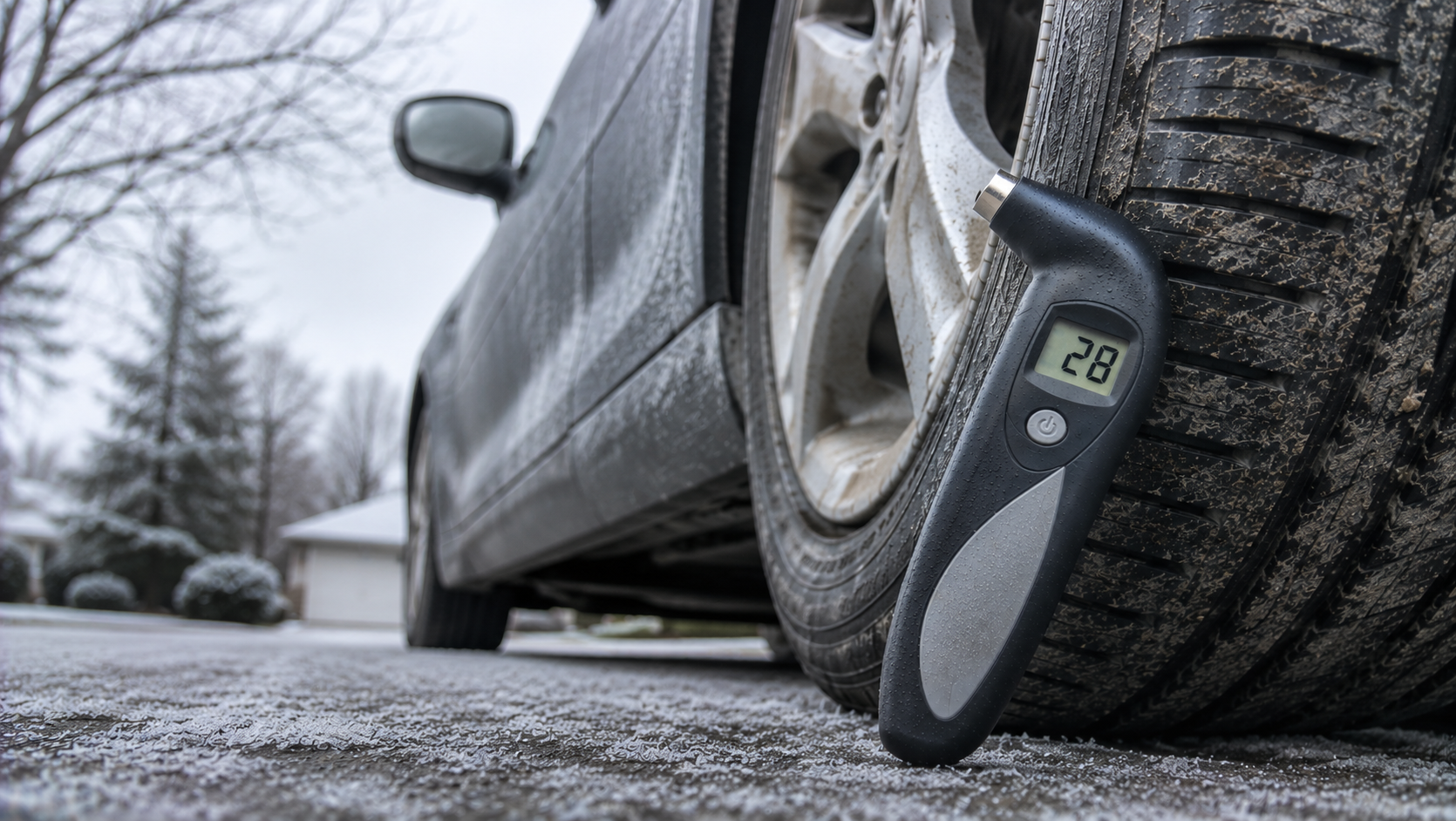
3. Measure the pressure.
Use a reliable tire pressure gauge to check each tire.
4. Compare the readings with the door-jamb recommendation.
Don't use the maximum PSI printed on the tire sidewall.
5. Add air if needed.
Bring your tires to the manufacturer's recommended cold pressure.
6. Watch the warning light.
Some systems turn off after the pressure is corrected and you've driven a short distance. Others may require a reset according to the vehicle's instructions.
If the warning returns, have the tire checked for a leak.
Or skip the guesswork and stop by Ellisville Tire & Service for a free tire pressure check.
How Often Should You Check Tire Pressure in Winter?
Don't wait for your dashboard to tell you something is wrong.
Checking tire pressure at least once a month is a good habit, especially when Missouri temperatures are changing.
It's also smart to check before a longer drive or after a major temperature drop.
A tire that's properly inflated one week may need attention after several freezing mornings.
Regular checks can help you catch pressure changes before they become large enough to trigger your TPMS.
And if your vehicle sits outside overnight, checking the tires before your first drive can give you a useful cold-pressure reading.
What If Your TPMS Light Stays On After Adding Air?
If you've corrected your tire pressure and the warning light remains on, there are several possible explanations.
Some vehicles need to be driven for a short distance before the system updates.
Others require a specific reset or recalibration procedure.
A warning that keeps returning may also indicate a tire that's still losing air.
And if the TPMS light flashes before staying illuminated, that can indicate a problem with the monitoring system itself.
Don't assume the warning can be ignored simply because you've added air.
If you're unsure what's causing it, have the tires and monitoring system checked.
A Free Pressure Check Can Be a Quick Fix
Sometimes, all your tires need is a few extra PSI.
At Ellisville Tire & Service, we make it easy to find out.
Stop by our shop, and we'll check your tire pressures and adjust them to the correct specifications.
If the pressure drop appears to be caused by the cold, we'll let you know.
If one tire is losing air faster than the others, we'll explain why a closer inspection makes sense.
Our Master Certified technicians know the tire problems that show up when West County temperatures fall.
And if everything looks good, we'll tell you.
No unnecessary upsells. Just straightforward advice from a local shop.
Keep Your Tires Ready for the Next Missouri Cold Snap
Cold weather can lower your tire pressure, but you don't have to wait for a dashboard warning to do something about it.
Remember the simple rule: approximately 1 PSI for every 10°F temperature drop.
Check your pressure when your tires are cold, use the recommended PSI on your vehicle's door-jamb sticker, and pay attention if one tire keeps losing air.
Ellisville Tire & Service is your local shop in Ellisville, Missouri, serving drivers from Ballwin, Wildwood, Manchester, Chesterfield, and across West County.
We're open Monday through Saturday, with Master Certified technicians who provide honest answers and straightforward service.
If your TPMS light is on, stop by for a free tire pressure check. No appointment needed for a quick top-off.
We'll help you figure out whether it's just the cold or a tire that needs a closer look, so you can get back on the road with one less thing to worry about.